
10 Deep Reasons Why Gas Cars Beat EVs in Today’s Nigeria
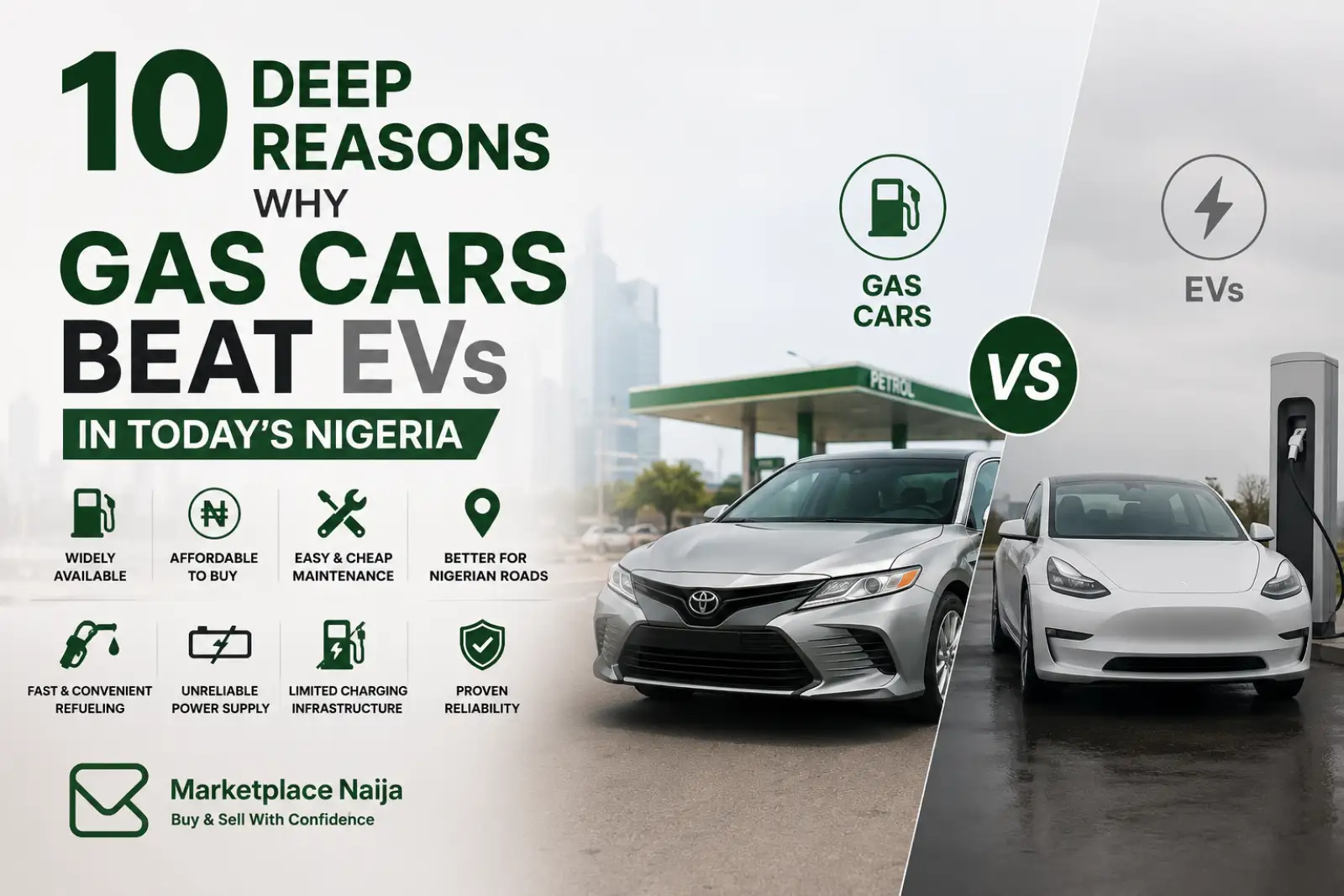
In recent years, the global automotive conversation has been dominated by the "Electric Revolution." From Tesla’s stock surges to European bans on petrol engines by 2035, it seems the world is ready to plug in. However, here on the streets of Lagos, Abuja, Port Harcourt, and Kano, the reality is quite different. While EVs are marvels of modern engineering, the Internal Combustion Engine (ICE) , the classic "gas car"remains the undisputed champion for the Nigerian driver.
At Marketplace Naija, we see thousands of vehicles change hands, and the data is clear: petrol and diesel cars aren't just a tradition; they are a logistical necessity. Whether you are browsing through our extensive cars category or looking for heavy-duty options in the broader vehicles section, understanding the "why" behind the dominance of gas cars is essential for making a smart purchase.
Here are 10 deep, fact-based reasons why gas cars are still better than electric in the current Nigerian climate.
1. The Energy Density Advantage (Physics Doesn't Lie)
One of the most overlooked facts in the EV vs. Gas debate is energy density. Gasoline is a miracle of energy storage. A single kilogram of petrol contains roughly 100 times more energy than a kilogram of the best lithium-ion batteries currently available.
In a country like Nigeria, where distances between major cities are vast and traffic jams in cities like Lagos can last for six hours, this energy density is a lifesaver. An EV carries a massive battery "weight penalty"often weighing 500kg or more just to match the range of a 50-liter fuel tank. When you buy a car from the Marketplace Naija car listings, you are buying a vehicle that spends less energy moving its own weight and more energy moving you and your family.
2. Infrastructure Resilience and the "Grid Problem"
Let’s be honest: Nigeria’s national power grid is currently not equipped to handle a massive influx of electric vehicles. Charging an EV is equivalent to running several industrial air conditioners at once for several hours.
While there are thousands of filling stations across the country, public EV charging stations are almost non-existent. For the Nigerian driver, the ability to find a petrol station in the remotest village in Ekiti or a highway stop in Kogi is a security feature. With a gas car, you are never more than a few kilometers away from "juice." Until the grid can sustain 24/7 power for millions of households plus millions of cars, petrol remains the only reliable option.
3. The "Kazeem" Factor: Maintenance and the Right to Repair
In Nigeria, we rely heavily on our local mechanics affectionately often called "Kazeem" or "Oga Mechanic." These craftsmen have decades of experience with Japanese, German, and American engines. They can dismantle a Toyota Camry engine and put it back together in a day.
EVs are "computers on wheels." They operate on high-voltage systems (up to 800 volts) that can be lethal if handled incorrectly. They require specialized diagnostic tools and software that is often "locked" by the manufacturer. If your EV breaks down in a place like Lokoja, finding someone who can fix a software glitch in a battery management system is nearly impossible. Gas cars offer the "right to repair," ensuring that your vehicle stays on the road through local ingenuity.
4. The "Tokunbo" Economy and Resale Value
Nigeria’s car market is driven by the "Tokunbo" (foreign-used) trade. A 2010 Toyota Corolla is still a hot cake on Marketplace Naija because it holds its value.
EVs, unfortunately, suffer from "battery degradation." Much like your smartphone, an EV battery loses capacity every year. After 10 to 12 years, an EV battery may need a replacement that costs more than the car is worth (often between $10,000 and $20,000). This makes the second-hand market for EVs extremely risky. A petrol car with 150,000 miles can still run perfectly with a basic overhaul; an EV with a "dead" battery is essentially a scrap metal heap.
5. Thermal Stability in Tropical Heat
Lithium-ion batteries have a "Goldilocks zone", they hate being too cold, and they really hate being too hot. Nigeria’s average temperature often hovers between 30°C and 40°C. High ambient temperatures accelerate the chemical breakdown of EV batteries.
Furthermore, in an EV, the air conditioning system is a massive drain on the battery. In a petrol car, the AC runs off the engine’s belt or an alternator-supported system that doesn't drastically "kill" your range. In an EV, stuck in a 3-hour Lagos "hold-up" with the AC on full blast, you will watch your percentage drop with anxiety. Gas cars provide consistent performance regardless of how hard the sun is beating down.
6. Flood Resilience and Road Conditions
We are all familiar with the rainy season in Nigeria. Flooding is a common occurrence in many of our cities. While EVs are designed to be water-resistant, they are not waterproof. If the seals on a high-voltage battery pack are compromised during a flood or by hitting a deep pothole, the result can be a "total loss" or even a fire hazard.
Gas cars are generally more resilient to the rough-and-tumble nature of Nigerian roads. The mechanical nature of the drivetrain is less sensitive to the vibrations and shocks caused by "lunar-crater" potholes. For a rugged environment, the simple, mechanical robustness found in the vehicles on Marketplace Naija is a safer bet.
7. Refueling Speed vs. Charging Anxiety
Time is money. You can fill a petrol tank in 3 to 5 minutes and be back on the road for another 500 kilometers. Even the fastest DC chargers in the world (which we don't have widely yet) take 30 to 45 minutes to reach 80% charge.
For the businessman traveling from Lagos to Benin, or the hauler moving goods across the country, those 45-minute stops add up. If there is a queue at the charger, you could be stuck for hours. The "Range Anxiety" associated with EVs is a psychological burden that Nigerian drivers, who already deal with enough stress, simply do not need.
8. Towing and Heavy-Duty Performance
If you look at the broader vehicles category, you’ll find trucks, vans, and SUVs used for hauling. Physics dictates that when you add weight to an EV (towing a trailer or carrying 7 passengers), the range drops exponentially.
Tests have shown that towing can reduce an EV’s range by over 50%. A petrol or diesel truck will also use more fuel when towing, but because you can refuel in minutes, it doesn't stop your progress. For commercial activities, logistics, and heavy-duty work, the internal combustion engine remains the only viable powerhouse.
9. The Initial Cost of Entry
As of today, EVs are significantly more expensive than their gas counterparts. Even with the rising cost of fuel, the "break-even" point where an EV becomes cheaper than a petrol car can take 7 to 10 years of driving.
For the average Nigerian family or small business owner, the upfront cost is the biggest barrier. Why pay 40 million Naira for an electric hatchback when you can get a luxury SUV or a reliable workhorse truck for the same price or less on Marketplace Naija? Gas cars democratize mobility by being affordable at every price point.
10. Flexibility in Emergencies
In a national emergency, a natural disaster, or a total grid collapse, a gas car is a survival tool. You can store petrol in jerry cans. You can siphon fuel from one car to another. You can run a fuel pump with a small generator.
An EV is entirely dependent on a complex, centralized electronic infrastructure. If the power stays out for a week, your EV is a stationary object. In a country where we value "self-reliance" and "personal backup systems" (like our home generators), the petrol car is the ultimate self-reliant machine.
Conclusion: Making the Right Choice
At the end of the day, the "best" car is the one that works when you need it to, where you need it to. While the world may eventually move toward electric, the current reality in Nigeria favors the roar of the engine over the hum of the motor.
Whether you are looking for a fuel-efficient sedan for your daily commute or a rugged SUV for up-country trips, you will find the best deals on petrol and diesel vehicles right here.
Ready to find your next ride?
-
Explore our Cars Category for the latest deals on Toyota, Honda, Mercedes, and more.
-
Check out our full range of Vehicles for trucks, buses, and specialized machinery.
At Marketplace Naija, we bring the market to your screen. Choose reliability. Choose petrol. Choose the engine that keeps Nigeria moving!